Making a Living?
The 1910 Federal Census for Grand Rapids listed ‘Gladys Lacey’ and revealed ‘Gus Lacey’ as head of the household of wife Violet, daughters Gladys and Arrabella, and son Morris. Grand Rapids city proper numbered about 133,000 residents, according to R. L. Polk & Co.’s 1910 Grand Rapids City Directory. The 1910 Federal Census recorded 70,000 residents were born in Michigan, while 63,000, or 47% of the population, were migrants from other states or immigrants from other countries. They sought a better life for themselves and their family. Many escaped poverty and starvation, political unrest, or religious persecutions. Others fled more perilous inhuman conditions that threatened their very lives. Only about 529 residents were black or mulatto, a miniscule .04% of the total population.
Thriving industries attracted many immigrants around the turn of the century. Timber floated down the Grand River to lumber mills. The lumber industry fostered furniture manufacturing that dates back to 1837. Previously turned by hand, steam-powered machines revolutionized the industry and by 1852 cabinets, chairs, beds and other furniture were exported to Chicago. The number of furniture companies grew and more goods were then exported around the United States, so that by the 1890s Grand Rapids was known as the Furniture Capital.
Wood-related industries also thrived, including wood ornaments for house building and piano and organ manufacturers; mattresses and bed springs; veneered goods such as umbrella handles, carriage bow and buggy whip sockets, curtain poles, and easels; wagons and carriages; and wooden shoes. These industries created demand for hotels, restaurants, retail, and service jobs. In order to maximize profits, business owners sought laborers to work long hours at hard, and often back-breaking, jobs at low wages. Perhaps family or friends wrote about plentiful jobs in Grand Rapids or news spread via the myriad rail connections that easily and quickly transported people and goods, but also spread the word like modern day social media that workers were needed. For many, especially unskilled blacks, a job was better than no job.
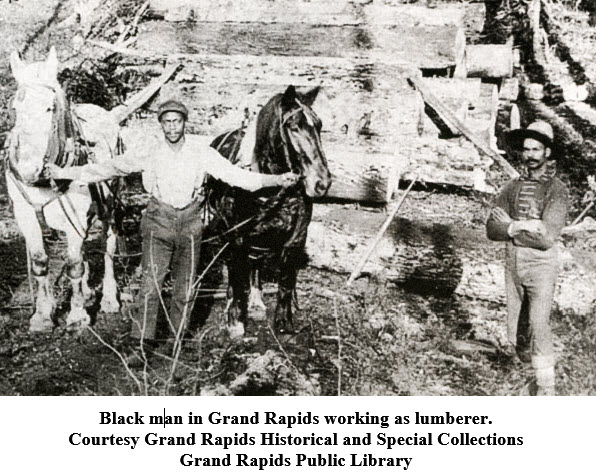
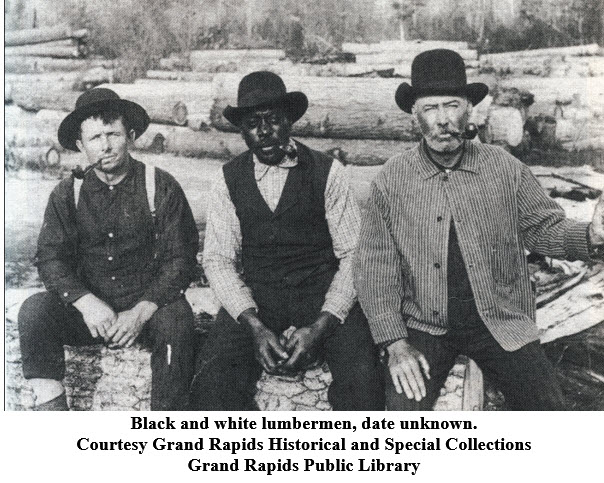
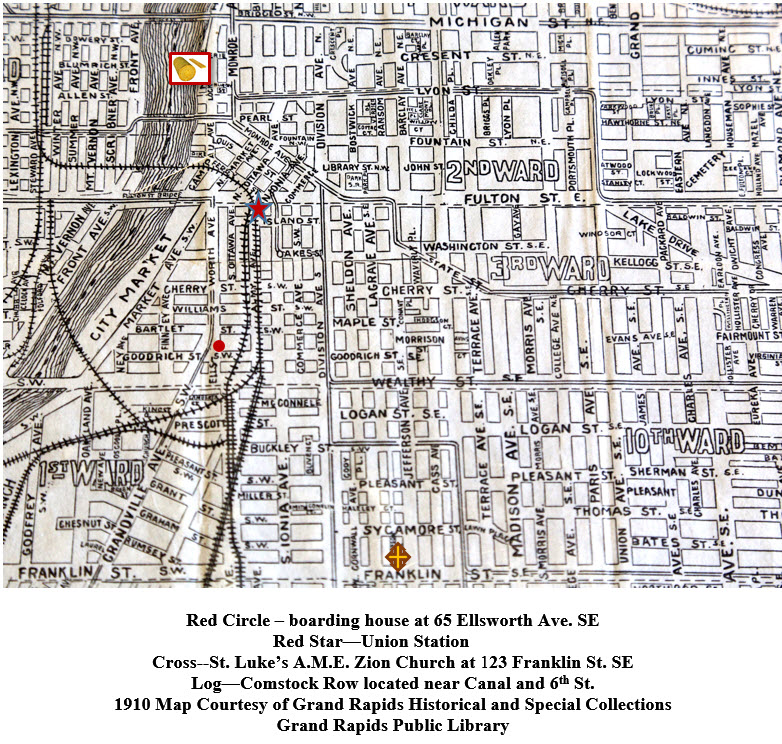
In 1910 Gus Lacey and his family lived in a boarding house at 65 Ellsworth Ave., a short street just west of Union Station. Also included in the household was 38-year-old black woman named Lucy Johnson. Her relationship to the Lacey’s is unknown. Other boarders included 66-year-old Charles Meaux, born in Missouri and a widower, who worked as ‘Proprietor of Confections; 2-year-old son Cecil, 54-year-old stepson Clentson DeAmmond born in Michigan (stepson at that age?), and an 18-year-old stepdaughter Clytie DeAmmond.
Other families on Ellsworth were born in Turk Assyrian, Ohio, New York, Illinois, and Canada. Interesting that the Lacey’s were the only black family living on that short street.
Blacks came to Grand Rapids as long ago as 1840, two decades before the Civil War. As described in The Story of Grand Rapids, A Narrative of Grand Rapids, Michigan, edited by Z. Z. Lydens, “Two men who had bought freedom from their masters came here because they believed their status as free men would be recognized.”
William Hardy, a free black born in New Jersey in 1823, moved to Seneca County, New York with his parents. Following the Erie Canal into Michigan, the family moved to Michigan. At age 6 or 7, William was bound out as a farmhand near Ann Arbor. He paid off his indenture, married, and in 1846 finally earned enough money to purchase two Gaines Township tracts of land, located in southeastern Kent County. In 1872, William Hardy was elected as the county supervisor for Kent County.
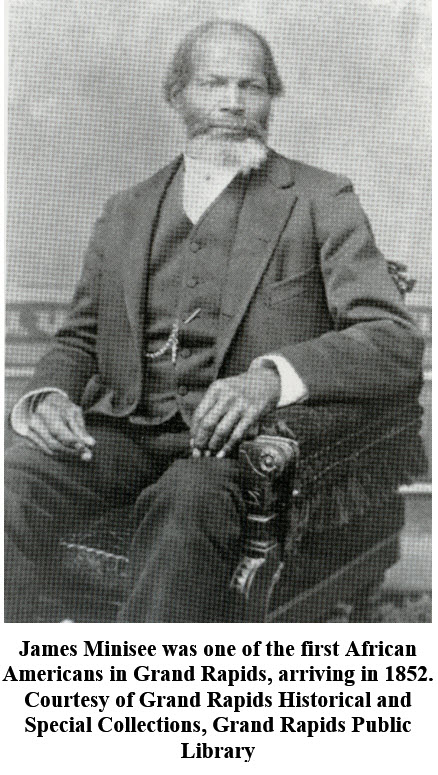
James Minisee arrived in 1852 from Pennsylvania, staying with Hardy family for a short time before buying his own farm.
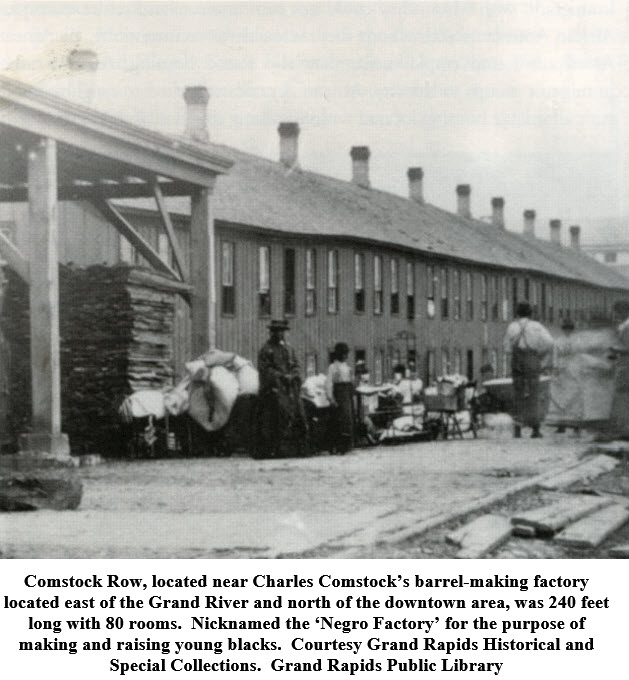
It was still before Lincoln’s proclamation that C. C. [Charles] Comstock brought in a band of colored people to work in his pail and tub factory at Canal and Sixth Streets. They came in 1860 and lived in houses on Comstock Row, west of Canal Street and north of the downtown area along the Grand River near Leonard Street.”
Grand Rapids then became a minor spur track in the Underground Railroad, with some fleeing slaves harbored in the mission, which later became St. Luke’s A.M.E. Zion Church.1 Located in a sparsely populated area in 1860 at 123 Franklin St., SE, the mission was only 1.5 miles south of Union Station.
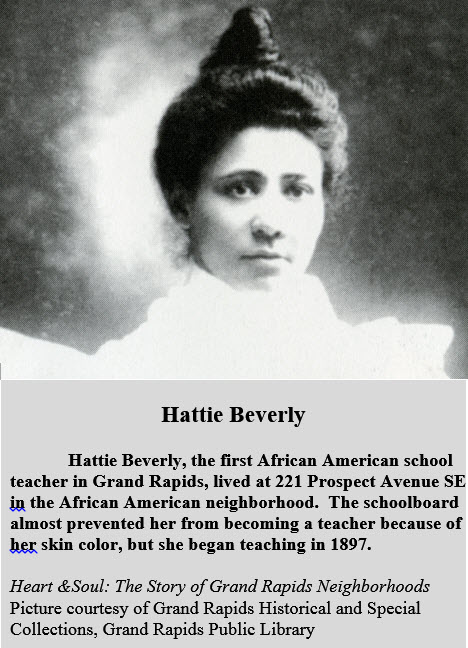
After the Civil War, other blacks migrated to the area, some becoming prominent leaders in the black community. Hattie Beverly became a teacher of a black school in 1897. The first black professional man to come to Grand Rapids was Dr. Eugene Browning, M.D., who arrived in 1905.
Clubs and organizations formed, such as the Colored Masons, Colored Knights Templar, the Married Ladies Nineteenth-Century Club, and the Grand Rapids Study Club.
Sadly though, decades after the Civil War freed the slaves, the blacks still lived in a segregated caste system that chained them to the lowest wages, hardest work, longest hours, constant discrimination, and isolated them from most white-dominated clubs, churches, organizations, and politics.
Grand Rapids mirrored that reality. A large number of poor blacks and European immigrants lived in the southeast area near the railroad station, sometimes called the ‘slums’ because of the squalid conditions and crowded tenement houses. The whites living in this area worked in the higher paying jobs. Teamsters, men who drove hundreds of wagons in the city, ranked as one of the largest professions. In 1903 they formed the International Brotherhood of Teamsters. Other white residents toiled as sanders; molders at iron works; candle makers; bookkeepers; blacksmiths; salesmen; veneer cutters; polishers; dressmakers—the higher paying jobs. Blacks who passed as whites also were allowed to work in these occupations. However, racism kept blacks from employment in any of these jobs.
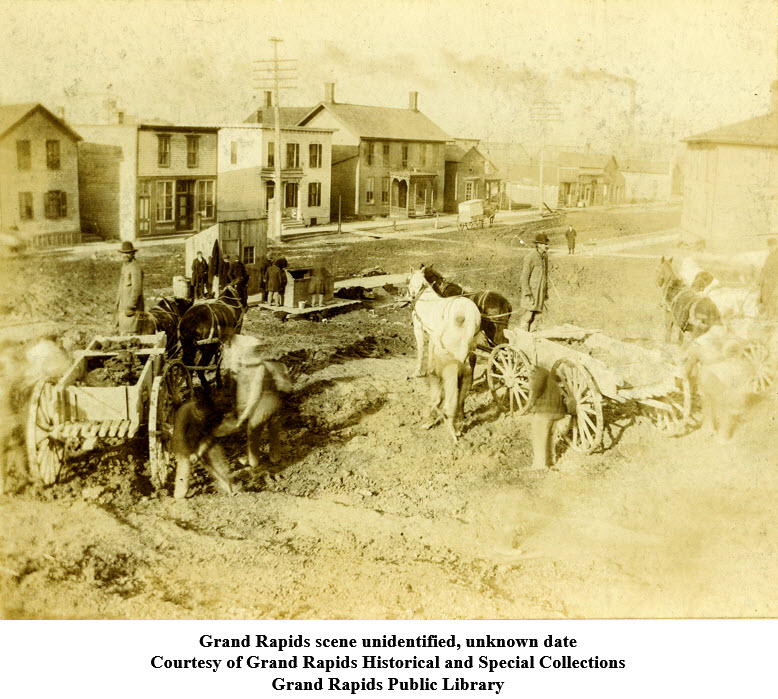
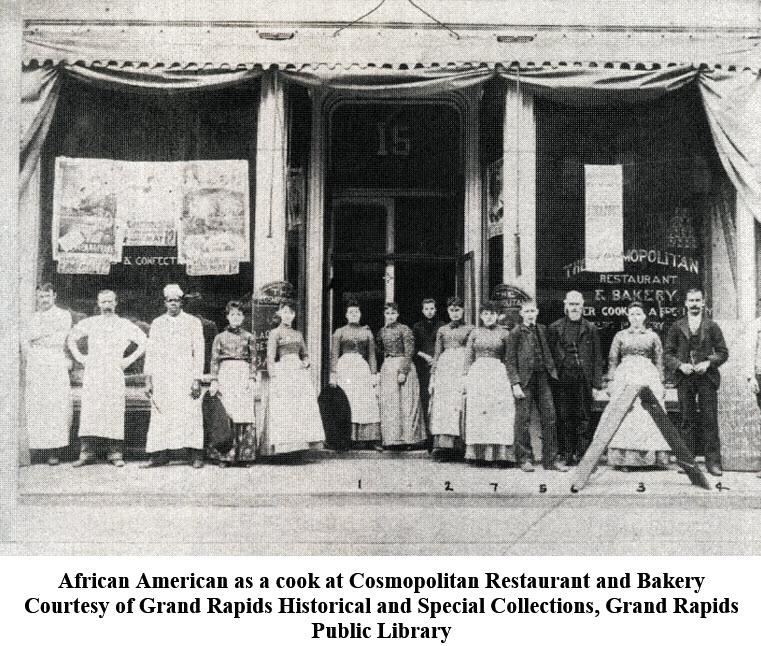
A small percentage of blacks owned their own business or worked in the higher paying occupations. The majority, though, could only find jobs as train coachmen or porters, cooks, maids or servants, waiters and waitresses, hotel porters or bellboys, laundresses, chauffeurs, proprietors of rooming houses, or simply as odd job laborers. The census listed Gus’s occupation as ‘laborer of odd jobs’. Violet did not work.
In 1910 the average U.S. worker earned between $200 and $400 a year. Even in the North, Blacks earned less than a small fraction of that amount, lower than the newly arrived foreign born laborers. These low-wage jobs barely paid expenses for one person, much less a family. Five-room apartments near Union Station cost from $8 to $30 a month.
Many of the blacks in Grand Rapids were single or married with no children. A few couples had one or two children, but most of these children were 18-years-old or older. To my astonishment, after looking at every black household 1910 record for Grand Rapids, Gus and Violet were the only couple who had 3 children, and all aged under 5!
How could Gus and Violet possibly earn enough to feed and care for their family?
Endnotes:
1The Story of Grand Rapids: A Narrative of Grand Rapids Michigan. Z. Z. Lydens, Editor. Grand Rapids, Kregel Publications, 1966. p.547. “History of St. Luke A.M.E. Zion Church.” History of St. Luke A.M.E. Zion Church. Web. 23 June 2015.
Chapter 6: Where Did They Go?


 by
by