


From Whence Did She Come?
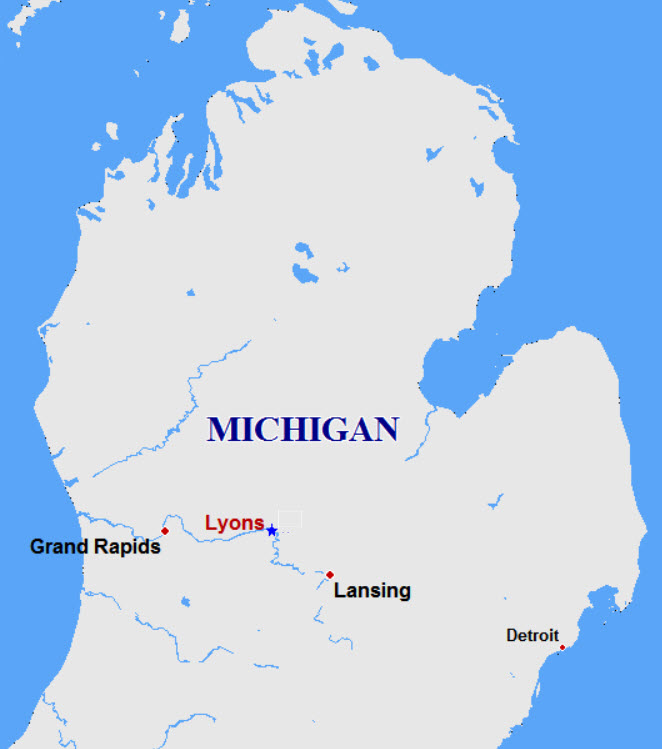 Now to guess where Gladys previously lived. Immediately two places seemed the likeliest—either Grand Rapids or Lansing. The railroad connected the 3 communities, with trains passing through Lyons several times daily. Grand Rapids was 49 miles from Lyons, while Lansing was about 38 miles away. But intuitively, Grand Rapids seemed more likely.
Perhaps statistics might help me choose. In 1910 the Grand Rapids population numbered 112,571 compared to only 31,229 living in Lansing. There were 659 blacks living in Grand Rapids, according to the U.S. Census, but only a few dozen lived in Lansing.
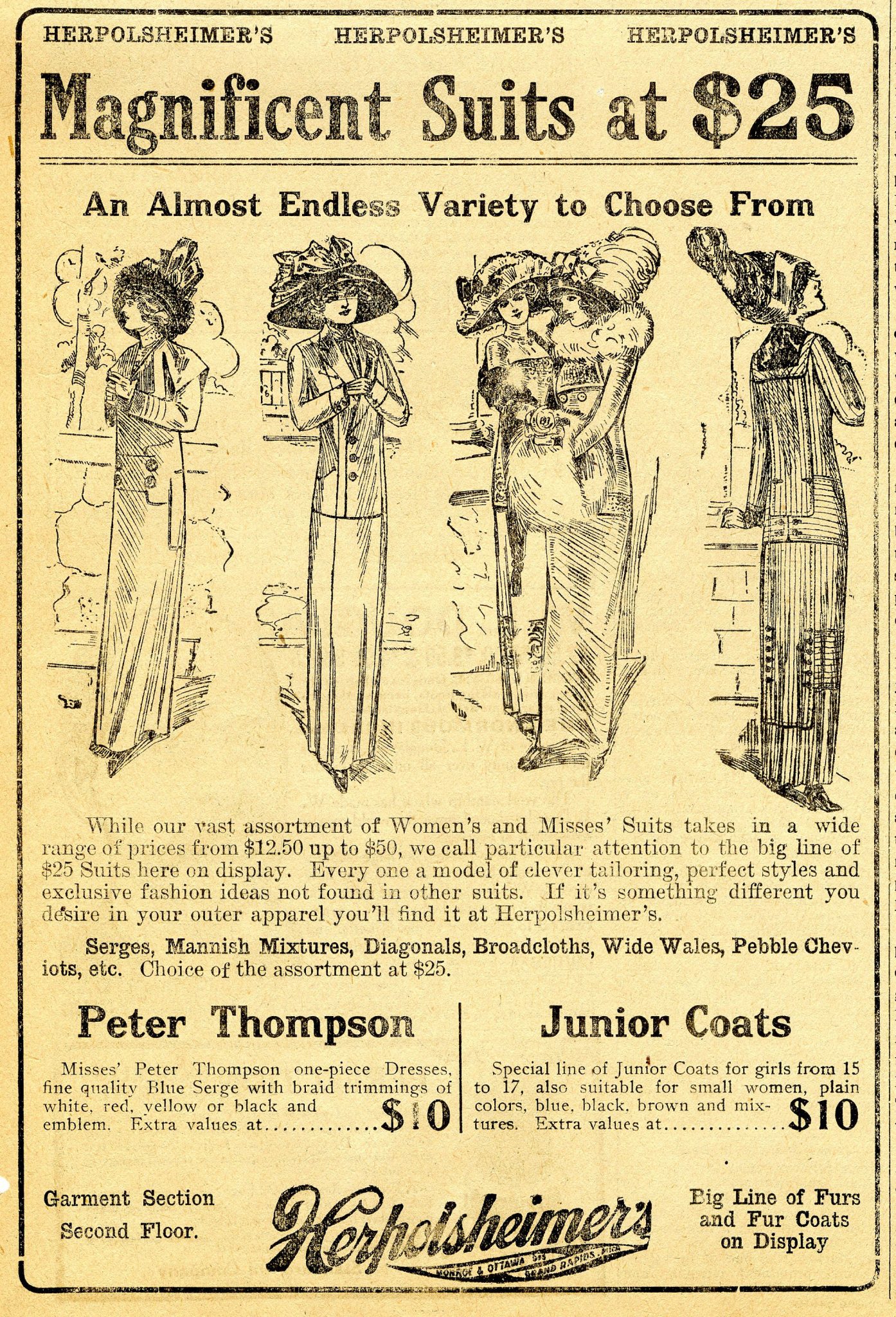
Then I remembered while searching through all the 1911 Lyons Herald issues, trying to discover when my great grandparents moved to Michigan, that most advertisements were from various Grand Rapids stores, especially the well-known Herpolsheimer’s department store. Darwin and Hope Wood earned a great sum of money when they sold their Iowa farm and moved to Lyons, Michigan. They took pride in wearing stylish, expensive clothes. The Grand Rapids advertisements probably persuaded them to select the larger city for shopping. Thus, the statistics and shopping mecca pointed to Grand Rapids, which became my search target area.
Next, I needed an online site with a large selection of what we librarians call ‘Reference Sources’ that easily and quickly provided data and information. Plus, the site must be populated with a large number of subscribers hosting family trees. The more family trees, the better chance that someone else knows information on my family member.
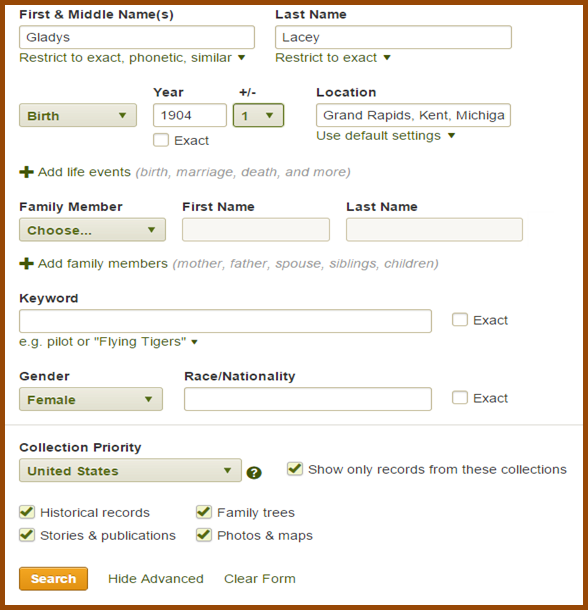
After researching the top genealogical subscription databases, I chose Ancestry.com for the large number of online sources, its international content, and its wide and active user-base. In the search fields I typed in ‘Gladys Lacey’; Birth as 1904, plus or minus 1 year; Location as ‘Grand Rapids, Kent, Michigan’; Gender, female; limited the search to the United States collections, and then pressed the Search button.
BINGO! EUREKA! HALLELIAH!
Wow! In only a few minutes Ancestry.com found a 1910 census record! At this point you need to understand my truly ecstatic appreciation of such speedy and easily retrieval information because it wasn’t always the case. But life is a matter of perception, so let me enlighten you on the ‘then’ and ‘now’ of searching census records so you might also share in my gratefulness.
The U.S. Census is conducted every 10 years in order to fairly apportion the number of federal representatives from each state, as well as to decide on the amount of direct taxes to be levied. Because the census contains important information about individuals, families, and communities, the records are the most frequently used records created by the federal government. The first census was collected in 1790, compiled into book format, and then retained at the National Archives and Records Administration in Washington, D.C. Searching for an ancestor required traveling the long distance to our nation’s capitol. In addition, each state library or archives might receive a duplicate set. Few individuals bothered looking for lost relatives due to money, time, or traveling constraints.
Then in 1941 the National Archives began copying census pages into machine-readable format and produced them onto long film strips called microfilm. Searching this format required a ‘reader’. During these ‘olden’ days before the Internet, a person traveled to a library that first, owned the census microfilm, possessed a microfilm reader, and offered interlibrary loan services, which allowed ordering census microfilm from other states. Mainly larger municipal libraries fulfilled these requirements and became magnets for genealogists, some who traveled hundreds of miles to research their ancestors.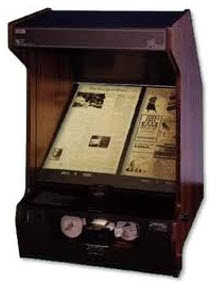
Each census microfilm usually contained data from just one county within a state. Some larger counties with very populous cities necessitated several microfilms. To read the data required sitting before a monstrous brown rectangular machine and peering at large black and white lit pages–often for hours. With no index and often only knowing the relative once lived in a particular state, the person slowly cranked the machine’s handle and read every single name on each line of every single village, township, or city in every single county of the state, hoping to find a name. Sometimes finding one relative took months to locate.
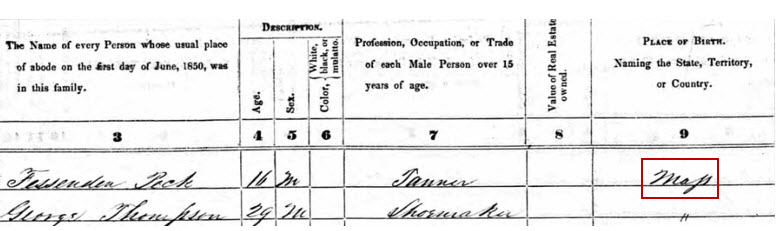
There were other search drawbacks. Old-fashioned handwriting gives older documents charm, but can be difficult to cypher due to crowded letters or sloppy writing. Faded or scratched microfilm resulted in many illegible pages. Adding more frustration, if a name or word contained double Ss, the first ‘s’ was written to look like a lower case ‘f” followed by an ‘s’, as demonstrated in the written state of ‘Mass’ below. Despite all these handicaps, many genealogists came back week after week, eyes riveted to the screen while looking for that needle-in-a haystack relative. With working, cooking, cleaning, and raising 3 children, no way did I have the time to search my family. So I watched in wonder and awe.
Back to searching for ‘Gladys Lacey‘. Once I pressed the ‘Search’ button, only a few minutes passed and then the name ‘Lacy Gladys’ appeared in the 1910 Federal Census for Grand Rapids. My mouth dropped in wonder and amazement. Clicking on the ‘hit’, Gladys past became clearer. The record listed the family members and other very valuable information.
Gladys was listed as female, black, born in 1904 in Michigan and 7-years-old in 1910. Even though of school age, she did not attend school. How sad!
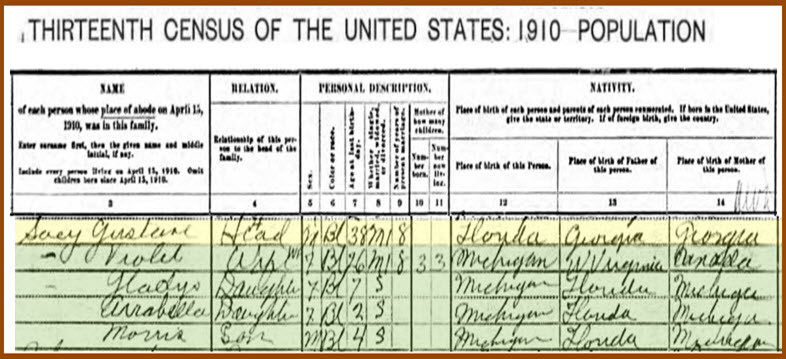
Gustave Lacy was her father, but an Ancestry.com user noted that the correct spelling was ‘Lacey’, the same as the notation on the back of the Wood Family Fishing picture owned by Cousin DeEtte.
Under ‘PERSONAL DESCRIPTION’ the records listed Sex, Male; Color or Race, Black; Age, 38, thus born about 1872; Married; and 8 for the ‘Years of Present Marriage’.
Then some very valuable clues appeared: Gustave was born in Florida, while his mother and father were born in Georgia. Now I can search information in both those states.
Gustave worked as a ‘Laborer’ under ‘Trade or Profession’; ‘Shop’ under ‘General Matter of Industry’; and ‘Working on Own Account’ rather than as an employer or someone’s employee. He could read and write and lived in a house as a renter.
Violet Lacey was Gladys’ mother and Gustave’s wife. She was black, aged 26 and thus born around 1883 in Michigan. Her father was born in West Virginia and her mother was born in Canada. Violet could not read or write.
The census record revealed other family members. Morris was 4-years-old, born in 1904 and Arrabella was 2-years-old and born in 1906.
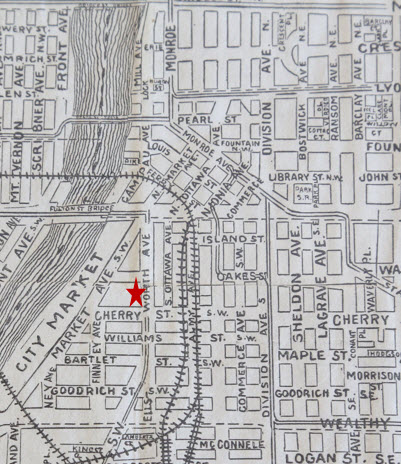 The family lived as renters in a house at 65 Ellsworth Avenue, south of Fulton Street and close to Oakes Avenue. Other renters included a white family consisting of a 66-years-old male head of household, his 54-year-old stepson, and an 18-year-old stepdaughter. Also renting was a 38-year-old black woman.
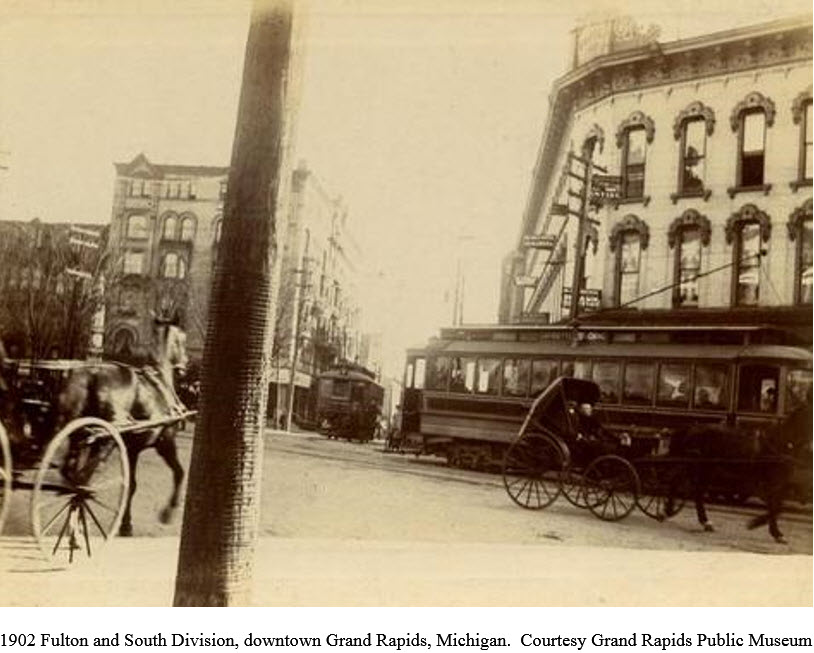
In addition to cheaper rents, the area buzzed with economic activity day and night. Jobs could be easily found, especially for blacks.
So now I wanted to know what happened to Gladys and her family, and that required searching through other census years and online information sources.
This is when I learned the Number 1 rule of all mysteries:
NOT ALL IS AS IT APPEARS
Chapter 4: Grand Rapids – Now and Then


 by
by 

Very interesting once again. Hurry up! I want to read the rest of the story!
Awesome research, Jenny! Next chapter soon?
Nice job of research Jenny. This is a great mystery and you are driving me crazy trying to solve it. Could you speed it up a bit? JUST KIDDING!
Oh, you haven’t seen anything yet! I went to Van Buren County to research and discovered an even bigger surprise.