


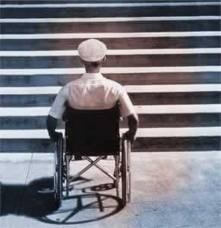
Few able-bodied persons realize how many barriers exist when trying to daily navigate public places, especially when the transportation mode is a wheelchair. Rae Bower encountered such barriers while living in New Zealand. Without curb cuts, sidewalks become a wall to a wheelchair user. Without wider doors into a public building or business, entry is barred. Without elevators, mobility challenged people must stay on the first floor. Even without automatic door openers, entrance depends on someone being around to help, but many times there is no one around. Especially important, without larger bathroom stalls, heeding nature calls become a real problem. Put all those barriers together and exclusiveness, isolation, and loneliness can become the norm for a person with a disability.
This is the new reality Rae faced, but what to do about it? She easily could have stayed cooped up in her newly built accessible New Zealand home. This world traveler, though, wanted to continue living her life independently, even though now confined to a wheelchair. Perhaps Rae remembered the Seattle area was easily accessible, becoming one of the first cities in the country that began putting in what they call ‘curb ramps’ long before the 1990 Americans with Disabilities Act, which mandated physical access to public entities at local (school, municipal, city, county) and state levels.
Mike Morris-Lent now is the Traffic Engineers Manager for the Seattle Department of Transportation and has historical memory of Seattle embracing accessibility decades ago. He relates, “Seattle established ramp program and standards in the early to mid-1970s. These were a product of a collaboration between what was then the Seattle Engineering Department and citizen pioneers in the accessibility field representing pedestrians who use wheelchairs and pedestrians who have limited sight or are blind. Agencies participated in the development of the ramp standards, including Easter Seals. I inherited responsibility for Seattle’s curb ramp program in roughly 1986-87 through about 1990. At that time, Seattle had it’s own annual program and set of design standards curb ramps. – in which the program designed and put in about 200 to 300 ramps per year at locations based on citizens’ requests.” Rae realized that accessibility could be achieved in Lower Hutt and perhaps elsewhere in New Zealand.
Activists come in all shapes and forms. This became clear to me when I read Lighting the Way: Nine Women Who Changed Modern America by Kareena Gore Schiff, former Vice President Al Gore’s daughter. Schiff profiled nine not very well-known 20th century change-making women. Some were loud,forceful, in-your-face, and it-must-be-done now activists. The half German side of me easily related to them, but I quickly realized they ended up alienating almost everyone around them. Others were quiet, soft-spoken, yet patiently tenacious–realizing that changes happen slowly, but more successfully, when using tactful persuasion, cooperation, and passion. The latter was Rae’s approach.
Utilizing her international marketing experiences, she began working with the area Multiple Sclerosis Society and other disability groups. Husband Doug recalled, “Rae really got things active. Her force was that she got people together as a group to be advocates. Within a few short years she had people coming to the house, doing typing and getting ready for meetings that helped to promote the accessibility. Rae had to find these people and often recruited college students, who kept in contact with her. Then the group approached the Lower Hutt Street Department, telling them this is what we need—sidewalks and curb cut-aways. Rae ‘s approach was simply asking, ‘Heh, help us out.’ Because it was a small town, you could make things happen faster.” Faced by so many mobility challenged town folk, Lower Hutt began ripping up streets and poured easily manageable curb cuts and sidewalks, becoming New Zealand’s first accessible community thanks to Rae’s quiet yet persistent advocacy.
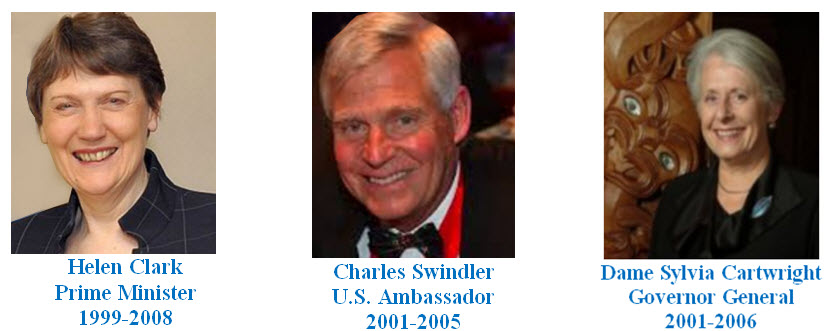
With pride Doug recounted, “That was how Rae got started. She became well-known down there. Through these organizations, we went to the U.S. Ambassador’s house several times, met the Prime Minister, and the Governor General of New Zealand—who works for the Queen of England. We went to various fancy affairs. Even though we lived in Lower Hutt a few years, Rae left an impression.”
NEXT: Rae Makes a Difference in Grand Rapids


 by
by 