Rae loved traveling overseas, especially throughout Europe, for her marketing job, but the supposedly clumsy missteps and falling increased. She was in Spain, fell and broke her leg, and had to return to Seattle. Rae healed and returned to Europe, when she fell again and broke her wrist. Suspecting something was seriously wrong, in late 1997 her doctor ordered brain magnetic resonance imaging (MRI) scans.
Doug and Rae spent little time worrying about the tests because in December 1997 they moved into their newly purchased two-story home — a house with stairs. She felt a little tired, but blamed the frenetic activities of unpacking and celebrating Christmas. Then one day she realized her legs would not move. Doug vividly remembers when they received the unwelcomed diagnosis—Multipe Sclerosis. The date was New Year’s Eve, 1997, and the New Year brought swirling and life-altering changes to the Bower family’s lives.
Like so many others diagnosed with a condition, the first thing on the list was to learn about the disease and become familiar with strange sounding parts of the human body, something few of us remember from biology classes.
Some mystery surrounds Multiple Sclerosi,or simply called MS. What is known it is a chronic disease that attacks the central nervous system—the brain, optic nerves, and spinal cord.
What Is MS?
 According to the National Multiple Sclerosis Society’s web site, “MS is referred to as an immune-mediated disease. As part of the immune attack, myelin (the fatty substance that surrounds and protects the nerve fibers) is damaged, as well as the nerve fibers themselves. The damaged myelin forms scar tissue (sclerosis), which gives the disease its name. When any part of the myelin sheath or nerve fiber is damaged or destroyed, nerve impulses traveling to and from the brain and spinal cord are distorted or interrupted, producing the variety of symptoms that can occur.” Think of the Star Wars Empire repeatedly attacking Luke Skywalker and the Rebels. (See Video) Destroyed nerves results in difficulty controlling muscular activity.
What is not known is the cause of MS. Scientists believe that a combination of several factors may be involved:
Environmental
MS occurs more frequently in areas farthest from the equator—such as northern Europe and in areas with northern Caucasian European descendants—like those who immigrated to New Zealand and the United States. Lack of vitamin D might be a factor, due to less sunlight. Vitamin D provides a benefial impact on immune function.
Infectious
Children are exposed to numerous viruses, bacteria and other microbes and since viruses are well recognized as causes of demyelination and inflammation, it is possible that a virus or other infectious agent is the triggering factor in MS according to some studies.
Genetic
While MS is not hereditary in a strict sense, but having a first-degree relative such as a parent or sibling with MS increases an individual’s risk of developing the disease several-fold above the risk for the general population. Studies have shown that there is a higher prevalence of certain genes in populations with higher rates of MS.
The doctors did not, or could not, tell Rae how quickly the disease would progress or how debilitated she might become. No two people diagnosed have exactly the same symptoms, and no two people will react to it in exactly the same way. Multiple Sclerosis affects about 2.3 million people worldwide, with the common age range between 20 and 50—Rae was 42. MS can appear in young children and teens as well as much older eldest.
Wanting to carry on with her life as much as possible, Rae returned to work. Within a year, she had to quit her job because she no longer could easily walk or travel extensively. She now used a cane and became easily fatigued.
Becoming an Activist
Fate marvelously intervened again, and Doug got a job offer from an American company in—of all places—New Zealand, and he eagerly accepted the engineering placement. No longer would Rae have to deal with climbing those steps in their house. Doug moved to the island in June of 2000, and Rae and Amy followed in July. New Zealalnd resembles California with its length and size. The northern region is very subtropical, the central area temperate with little snow, and the southern part much cooler. Blessedly the job was in Lower Hutt, population 25,000, located outside of Wellington and in the temperate southwestern part of the North Island. Rae’s mom and brother now also lived in the southern part, on an island.
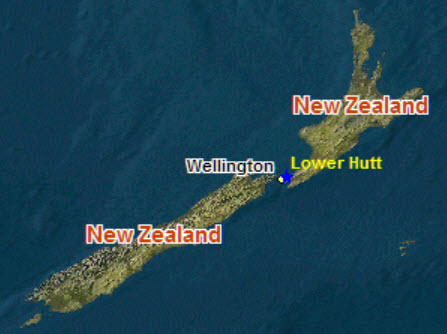
Soon after arriving, Rae no longer could walk and went to a wheelchair. The couple decided to build an accessible house, and as Doug proudly stated, “Built the best house we ever had” in size, beauty, and blessedly, accessibility.
While maneuvering the wheelchair in the house was easy, independently navigating the suburb’s sidewalks and business entrances was impossible. The 1990 Americans with Disabilities Act, which mandated physical access to public entities at local (school, municipal, city, county) and state levels. Thus sidewalk curb cuts and sloped entrances started becoming the norm throughout the country. In far away New Zealand, especially little Lower Hutt, accessibility for persons with a disability was not a social rights issue–until Rae became a community activist.
Next…Beginning a Social Movement in a Big Way.


 by
by