


Grand Rapids – Now and Then
Walk the streets of present day downtown Grand Rapids, Michigan and stop for a moment, close your eyes, and listen. The constant, yet quiet, rumbling hum of car engines surround you. Here and there, a ‘vroom’ greets your ears as cars accelerate when red stop lights turn green.
Open your eyes and look around slowly. Parked cars line streets and parking lots. Barely visible cocooned passengers pass by in almost hermetically enclosed cars that create sound barriers from most outside noises. while also containing any loud music blasting from media devices or screaming children.
Amazingly, the paved streets and sidewalks are free of any trash or foul garbage.
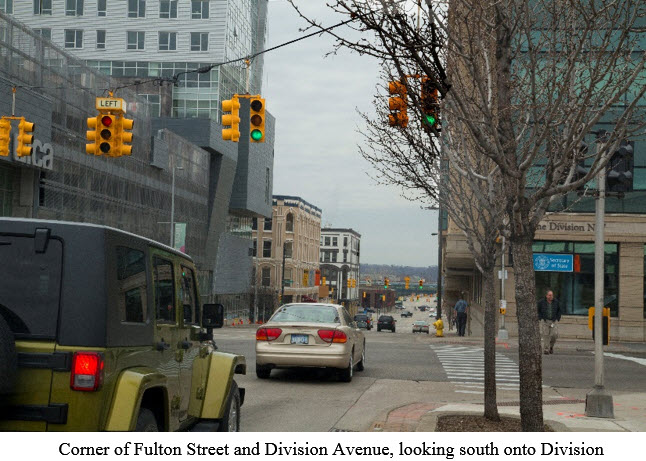
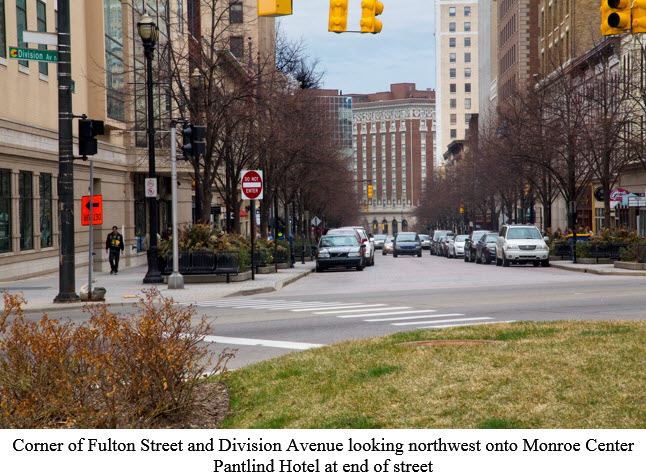
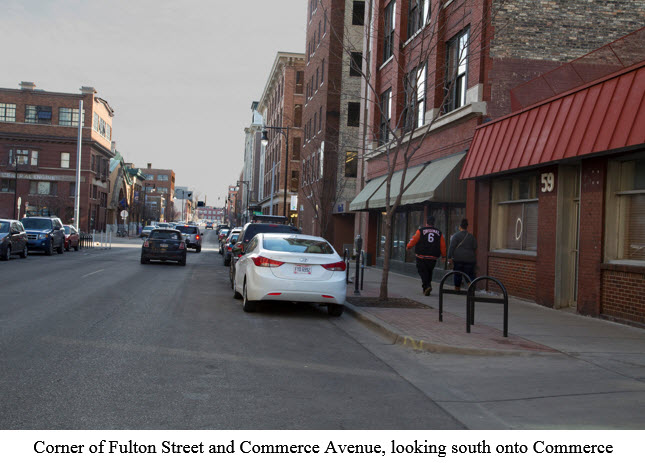
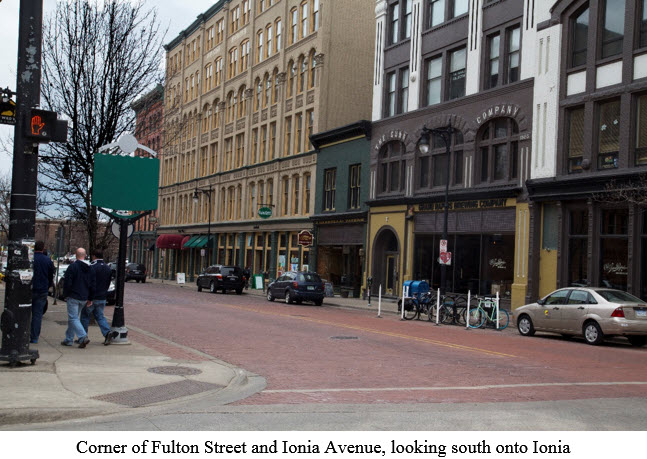
Except for special festival occasions, your gaze might be interrupted during the day by a few pedestrians, who soon disappear around the corner or into a building. At night, more people walk the sidewalks, but soon vanish into one of the many bars, brew pubs, or restaurants. On weekend nights, the customers might stand in line waiting to enter a popular night spot. Occasionally, a group gathers to talk for a short time. During warm months, outside restaurant tables host customers who converse in quiet tones. A few sit or recline in Rosa Parks Circle. But overall, the sights and sounds seem almost peaceful, soothing, and tranquil.
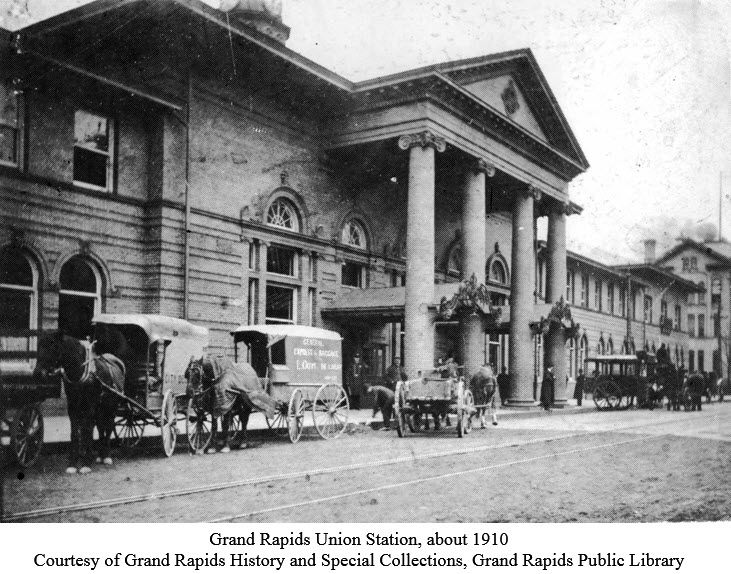
In 1910 the downtown Grand Rapids sounds and sights were anything but quiet. Horses pulling buggies and wagons dominated the streets. Neighing, snorting, clip – hoof sounds filled the air. Various sized open-air or enclosed buggies, pulled by one or two horses, carried passengers to work or to religious and social occasions. Male drivers sat high on open-aired wagons that creaked and moaned from bouncing springs, harnesses, and heavy loads. Slapping whips helped the horses behave or trot faster. While resting, the horses noisily chomped from feed bags or drank from water troughs. These animals left waste material everywhere on city streets and during hot summers the pungent smells filled the air.
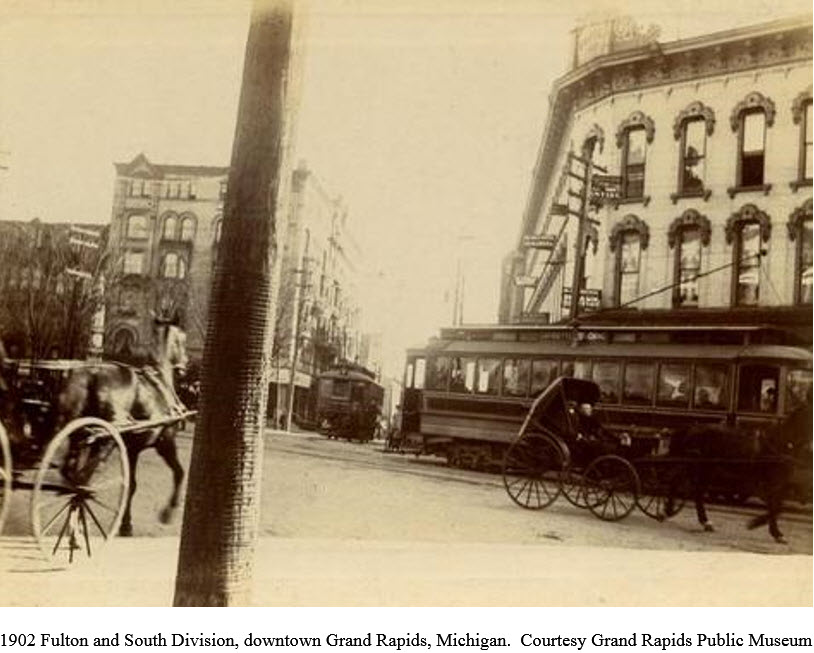
Adding to the aroma, garbage wagons filled with human and animal waste often remained unattended for some time, or even days. No refrigeration meant food might become sour, moldy, or rancid. Every man, woman, or child was a litter bug. Men chewed tobacco and spit whenever and wherever they wanted. Wood and coal-burning furnaces and stoves spewed out smoke and ashes that filled the air and covered the ground with soot, turning winter snow black.
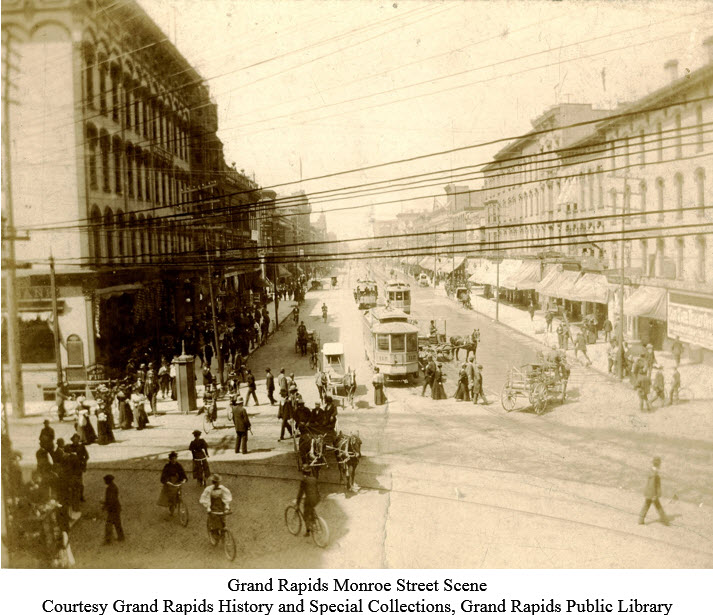
Electric streetcars provided mass transportation, creating unique sounds as the metal-wheeled cars rolled on special steel rails that were placed in the middle of the street. One pole connected to overhead electric wires. To prevent electrocutions, the circuit path allowed electricity to pass through the wheels to the tracks and finally into the ground or “grounded.” Streetcars were definitely cleaner than horses, but clacking wheels, clanking bells, and screeching brakes added to the downtown noise.
Some of the more affluent residents owned automobiles, which at that time were open-aired and very noisy. Only 4 men owned ‘motor cars’ in 1900, according to The Story of Grand Rapids: A Narrative of Grand Rapids, Michigan, edited by Z. Z. Lydens. By 1904, the Grand Rapids Automobile Club sponsored a ‘grand auto tour’, involving 12 local autos. In 1907 “the Kent County sheriff found himself harassed by irate farmers demanding money from motorists for scaring their horses.” That same year, a citywide survey found that there were 50 women drivers.
With no stop lights, occasionally street intersections created the city’s first traffic jams as automobiles, streetcars, wagons, and buggies vied for right-of-way. Needless to say, the air reverberated with loud exclamations and curses.
For some, bicycles provided a cheap, faster transportation mode. But the rider needed to maneuver around all the motor cars, horses, buggies, wagons, and electric car rails. Of course, the cheapest way to get around was simply walking and the pedestrians crowded the downtown sidewalks. Unlike today, most of the businesses and shopping was concentrated within a short walking distance of the Fulton Street and Division Avenue intersection.
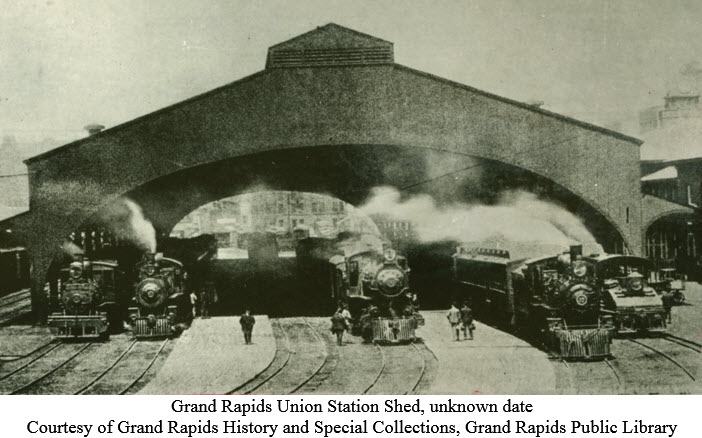
What probably created the most and loudest noises and greatly fueled the demand for these transportation modes—plus stimulated commercial, retail, and business activity—were the daily Grand Rapids Union Station train arrivals and departures, close to the downtown area at 61 Ionia Avenue SW. The Story of Grand Rapids: A Narrative of Grand Rapids, Michigan noted that in 1905, 20,000 trains, 100,000 train cars, and 750,000 people passed through the depot. On a daily average, passengers purchased 1,000 tickets and another 1,000 passengers arrived.
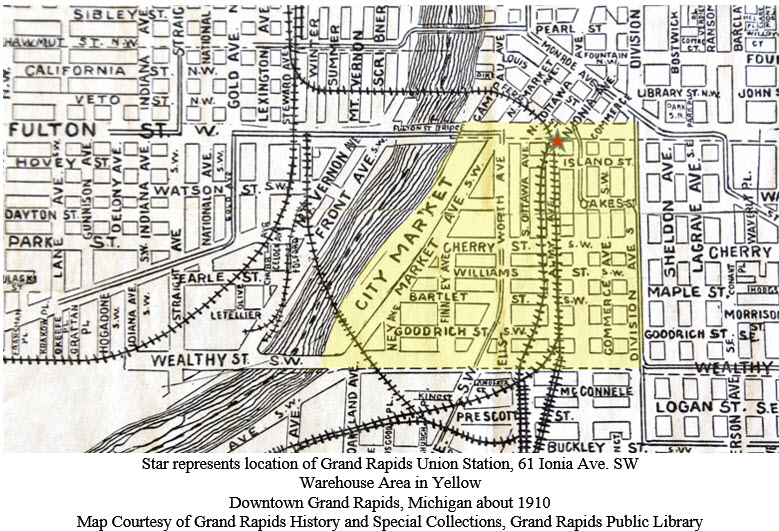
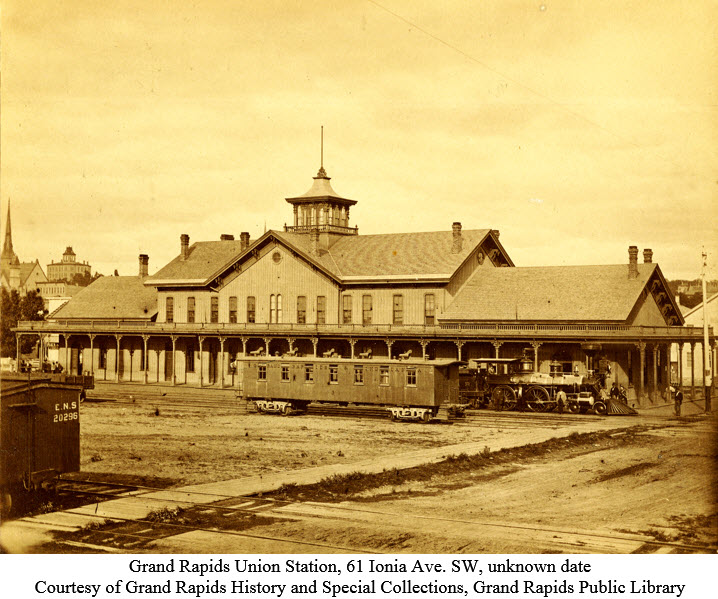
Wagons lined up outside the railroad depot to unload perishables such as agricultural products and farm animals and equipment; beer and liquor; fresh meats, dairy products, and produce; department store clothing and household products; construction materials; and manufacturing equipment and parts, and other shippable products.
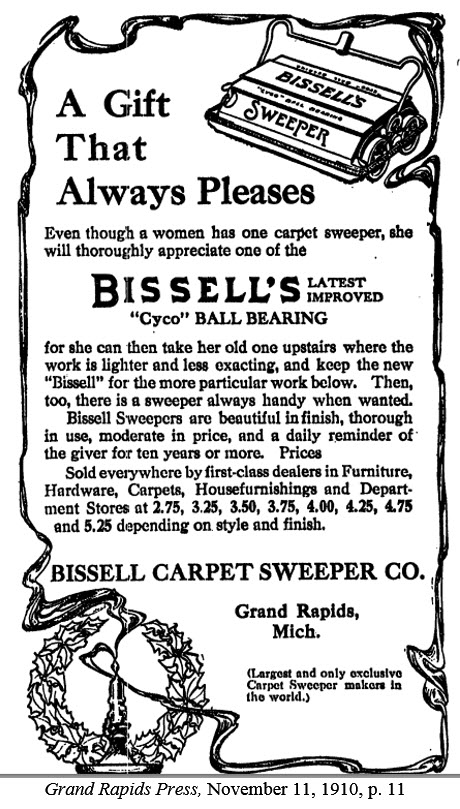
Manufactured goods shipped out included a large quantity of household furniture, since Grand Rapids was the furniture capital of the world then; cigars produced in 50 cigar factories; boots and shoes, especially hand-made wooden shoes; band instruments; 25,000 to 30,000 bicycles produced by 6 factories; wagons, lighter rigs, buggies, road carts, sleighs,and family carriages plus saddle and harnesses; knitted goods made the area a knitting center; millinery businesses produced a large number of hats for women and men; and sweepers from the Bissell Carpet and Sweeper Co., which produced 1,000 sweepers a day that were shipped around the world.
In 1910, Gus Lacey, wife Violet, and children Gladys, Morris, and Arrabella lived in one of the boarding houses and probably hoped to find economic prosperity. But being black presented difficult barriers nationwide and in Grand Rapids.
Next: Finding Gladys. Chapter 5 – Making a Living?


 by
by 

Your stories are so interesting, Jenny! Wish they weren’t so far apart; keep ’em coming!
Great reflections … I had wondered what Grand Rapids looked like then and now. Excellent writing; keep it coming, Jenny!
Hopefully you already know a lot more but just haven’t had time to put it to words. Hurry up! I’m anxious to find out how this mystery ends. Good job by the way. ????