


Doug and Rae Bower left New Zealand in June 2004 and returned to Seattle, Washington. Searching for a mechanical engineering position, Doug accepted a job with a Smiths Industries Ltd. in Grand Rapids. The British corporation purchased Lear-Siegler, an aviation parts manufacturer. The Bowers then moved to the community in late 2004.
They looked for an accessible house, but found none without entrance steps, so they decided to build an accessible home. Until the house was built, the couple chose an extended stay motel close to Doug’s job that was several blocks south of the 28th Street southeast popular shopping district
Independent-minded Rae made an appointment with a dentist, whose office was located a half-mile away, north of 28th Street. She assured Doug she didn’t need him to drive her to the office since the office was close, so he drove to work. Now a master of her electric-powered wheelchair, Rae easily breezed out of the motel only to suddenly come to a halt minutes later. Looking to the right, left, and then straight ahead, she realized there were no sidewalks! In a city of this size and in this modern time, in this busy area, where were the sidewalks?
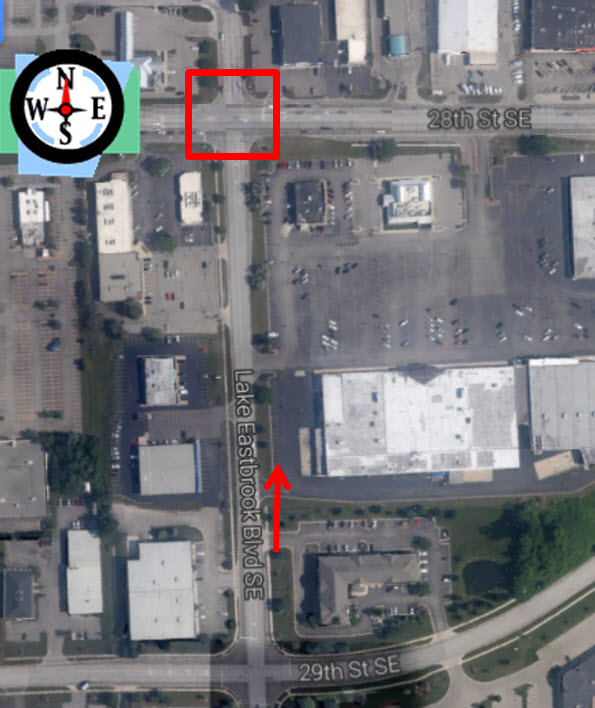
The only option was to travel on the street, where she saw and felt the cars whizzing by—just missing her by inches. Finally reaching the 28th Street SE and Lake Eastbrook intersection, Rae faced an even scarier realization—no crosswalk button existed that stops all the traffic, allowing her to safely cross. She didn’t know that this five-lane thoroughfare was one of the busiest street sections in all of Michigan. Vehicles raced by or speedily turned, resulting in few minutes when all traffic stopped. But cross the street she must!
Miraculously, Rae navigated to the other side. Then after visiting the dentist, she experienced the same hazardous journey back to the motel. Most would become, and remain, eternally angry over this experience. Rae realized that a public area not easily accessible became a barrier not only for her, but for many others in the community. Changes needed to happen.
By happenstance, in early 2005 Rae discovered Disability Advocates of Kent County (DAKC) promoting ZeroStep barrier free housing concepts at a Homebuilders’ Exhibit in the mall. To her surprise, the nonprofit’s office was only a mile from the motel. She asked for the executive director’s name, Dave Bulkowski, and soon related her experience to him and declared, “We have to do something about this situation and I’m going to help.” And help she did.
She volunteered to become a DAKC board member, and we met at her first meeting. She appeared serene yet confident. Of course, we all fell in love with her lyrical accent. Few knew of her successful sidewalk accessibilty improvements in New Zealand or about her numberous international marketing trips. When I became board president, she was elected secretary/treasurer. A few years later she assumed the presidency role.
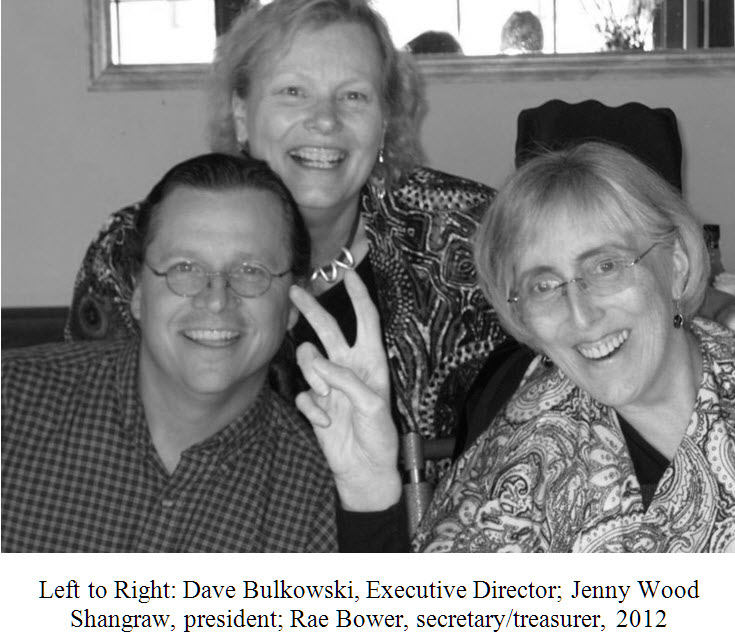
My passions were, and are, employment for persons with a disability. Immediately she focused on accessibility and transportation. Since I drove a car, I knew little about our region’s transportation barriers. From her I learned that a person could not travel by bus from Rockford in northeast Kent County to Byron Township, located in the southwest county corner. As medical facilities sprung up on the East Beltline, Rae informed the board that no buses traveled to that area.
Since I drive, I knew little about persons with a disability or seniors who cannot drive and their dependence on our area’s busing system. Every trip must be planned days, if not a few weeks, in advance to make reservations on the Go!Bus that comes to a person’s residence, stops at the designated location, and then later picks up the individual for the return trip. Being a spur of the moment person, I plan trips at the last minute. So Rae also explained how patient one must be waiting for the bus, which might be delayed many minutes. Often, riders waited outside in cold or rainy weather conditions. She never complained about such inconveniences. Even at some of DAKC’s board meetings, Rae needed to leave early because her bus had arrived. We learned to shorten the meetings. After being enlightened, I noticed that at every event sponsored by DAKC, many Go!Buses drop off or pick up riders, and an appreciation grew for the independence and high value our bus service provides.
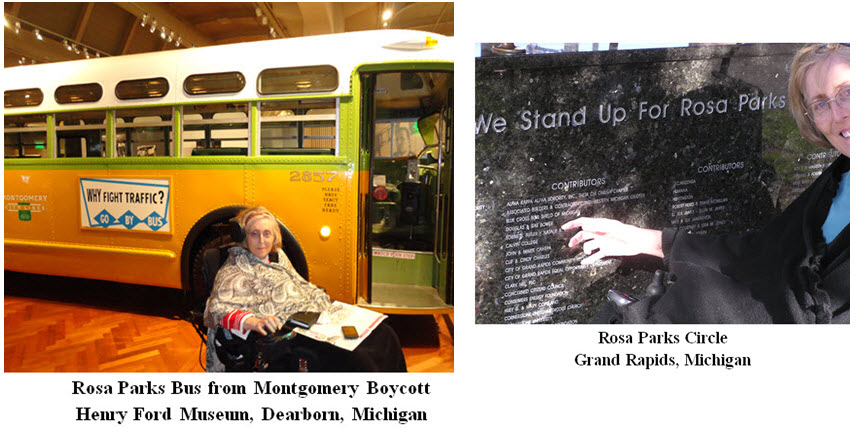
Rae taught me what an ardent advocate is and does. She greatly admired Rosa Parks, the African-American woman who was forced to give up her bus seat in the ‘Negro Only’ section to a white person, because the white section was filled. Parks trained several years for just this moment, and her refusal sparked the 1955 Montgomery Bus Boycott that eventually resulted in passage of the 1964 Civil Rights Act of 1964 prohibiting discrimination of any kind based on race, color, religion, or national origin. Rae felt a connection to the leader and became excited to learn the No. 2857 bus became a museum piece at Henry Ford Museum in Dearborn, Michigan. Rae also felt pride that Grand Rapids named its renovated downtown plaza the Rosa Parks Circle. Empowered by Rosa’s actions, Rae frequently volunteered to travel to our Lansing’s Capitol to speak with our region’s Michigan representatives about legislation that might positively impact persons with a disability.
She realized that inclusiveness must be a goal for every community. Exclusiveness to Rae meant not being able to independently navigate sidewalks or easily find affordable transportation or housing, so she learned which Grand Rapids organizations might be able to make community changes. She attended meetings where those issues might be addressed, was appointed to several boards, and then became a Grand Rapids community spokesperson for accessibility, inclusiveness, and independence.
- In 2007 the City of Grand Rapids Mayor, George Heartwell, asked her to join the Community Relations Commission, which encourages racial tolerance and community harmony.
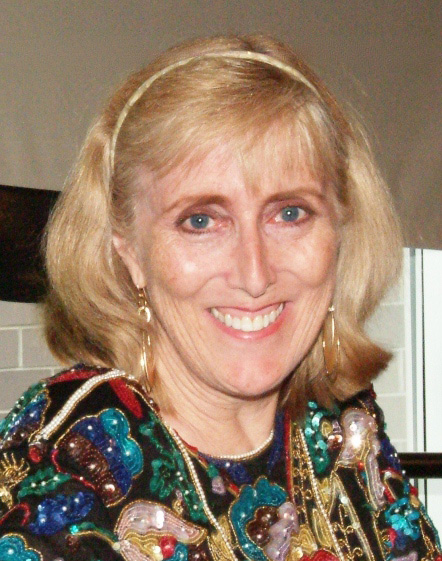
at Grand Rapids CommunityRelations Committee
- In 2009 the Consumer Advisory Commission of ‘The Rapid’ Transit Company chose Rae to serve on its board. When the Internal Revenue Service moved without notice from Grand Rapids to Grand Rapids Township, where the nearest bus stop was one mile from the new location, Rae spoke for persons with a disability who must use public transportation by politely protesting such an inconsiderate move in a Grand Rapids Press article entitled IRS Move Outside Grand Rapids Left Bus Riders in Cold….
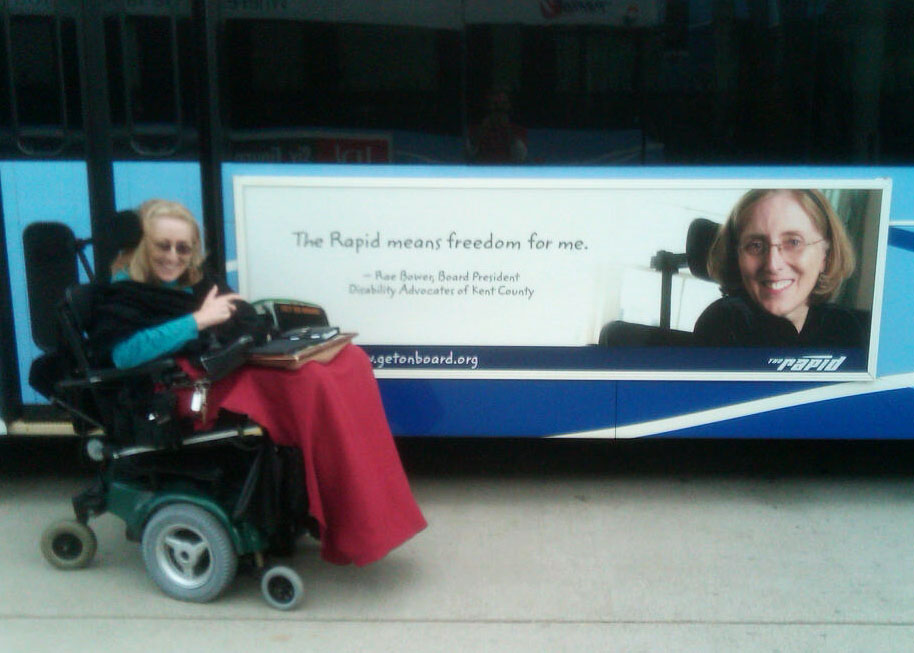
- In 2010 ‘The Rapid’ filmed Rae movingly advocate to expand Kent County bus routes and accessibility. Click on the link to see video: https://www.youtube.com/watch?v=sby1FaA1dYo. Soon her smiling face appeared on billboards and on the sides of buses.
- And Rae relentlessly continued to plead for sidewalks on 28th Street. Being Rae, she took her vision further. Led by Suzanne Schultz, City of Grand Rapids Planning Department, a Sustainable Streets Task Force convened and adopted a vision dear to Rae’s heart:
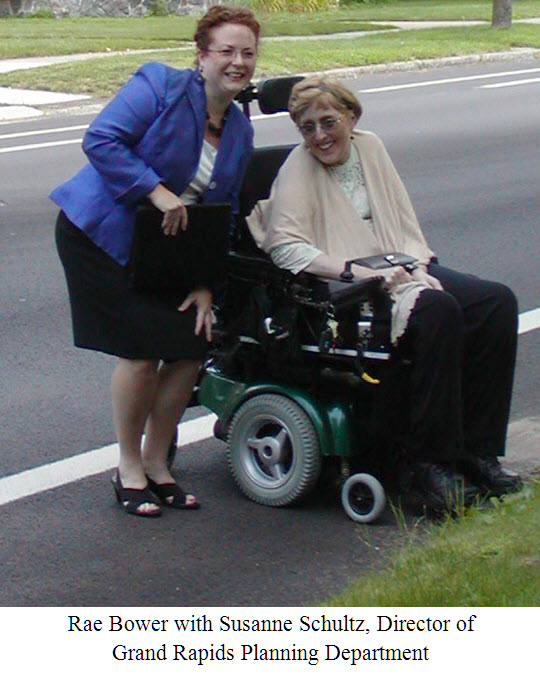
“City streets and rights-of-way will be accessible, attractive, and safe; serving all people of our community, contributing to the livability of our neighborhoods and business districts, and increasing economic opportunity to all individuals, businesses, and new development.”
Multiple Sclerosis effects worsened and Rae’s health and physical strength slowly began deteriorating. Each year, from 2009 to 2013, she spent a week to three weeks hospitalized at a time. As Doug related, she had bladder infections that were the result of her catheter. Then Rae broke bones—once when she fell from her shower chair and another time when Doug accidentally stumbled while lifting her. She appeared much weaker and extremely fragile.
Many times, my sixth sense alerts me that someone might be experiencing some difficulty. On January 28, 2013, I emailed Rae asking if I could interview her for my new blog. Doug replied two days later:
“Rae has been in the hospital for a couple of weeks with a blood and kidney infection. Her kidney shut down for a few days. She came home for a week but is not doing too well. She cannot use the computer and can barely speak a few words at a time. They are taking blood samples several times a week for the next month to see if the kidneys are getting better. I had to bring her back to the hospital as she was unresponsive. She is in ICU and the doctors didn’t understand what was wrong with her yesterday. Hopefully she’ll get stronger as time progresses.”
Sadly, Rae died five days later on February 5, 2013 and her Grand Rapids obituary appeared a few days later. Her advocacy affected so many people, that family and friends gathered to celebrate Rae’s life on Valentine’s Day, February 14th. The date and location were so appropriate—Valentine’s Day that represented her love for independence, others, and our community and The Rapid’s administrative headquarters where she participated in many planning sessions. Many voices shared touching stories, but Dave Bulkowski, DAKC Executive Director and Peter Varga, CEO of The Rapid, best encapsulated her effect on all of us and you may see and hear these tributes at http://www.youtube.com/watch?v=VT-W0I29XNI.
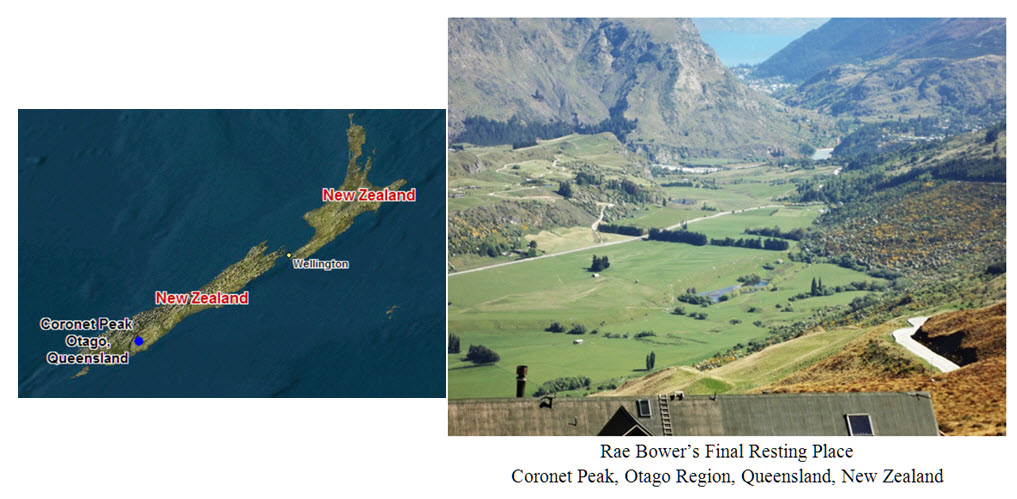
In late November, 2013, Doug and daughter Amy took Rae’s ashes back to her beloved New Zealand. She chose the perfect place on Coronet’s Peak in the Otago region of Queensland, lower New Zealand. If you look between the mountain gap, you might catch a glimpse of her freely and happily roaming around.
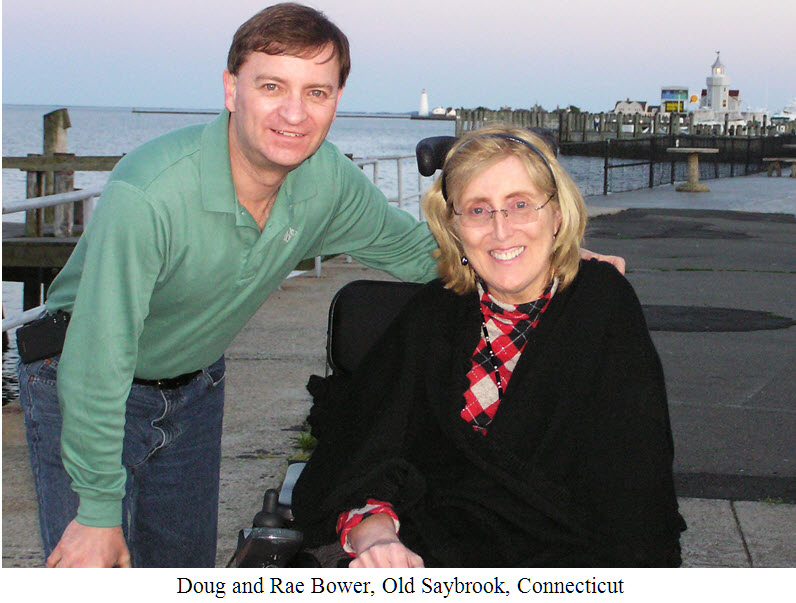
There is one hero we must not overlook and that is Doug Bower, Rae’s husband. He lovingly and patiently cared for her every single day and continued traveling with her. Many times over the years I saw a spouse, mainly the husband, leave because the partner became disabled. The person not only dealt with the newly acquired disability, but felt devastated by being rejected and abandoned, just when love and support was desperately needed. So I had to ask the question, “Doug, did you ever think of leaving Rae?” He looked absolutely surprised and aghast and his short, but firm, answer touches my heart and brings tears to my eyes even now, “No, I loved her.” There is no finer tribute.


 by
by 
Rae truly is one of my most memorable heroes.
As always, I have again been touched and moved by your very kind and passionate description about the exemplary life and loves and perseverance of Rae Bower! A remarkable eulogy for an incredible lady!
It was nothing less than truly characteristic of yet another of my heroes-you-Jenny Shangraw!
Keep up your great work!
Dan A.